
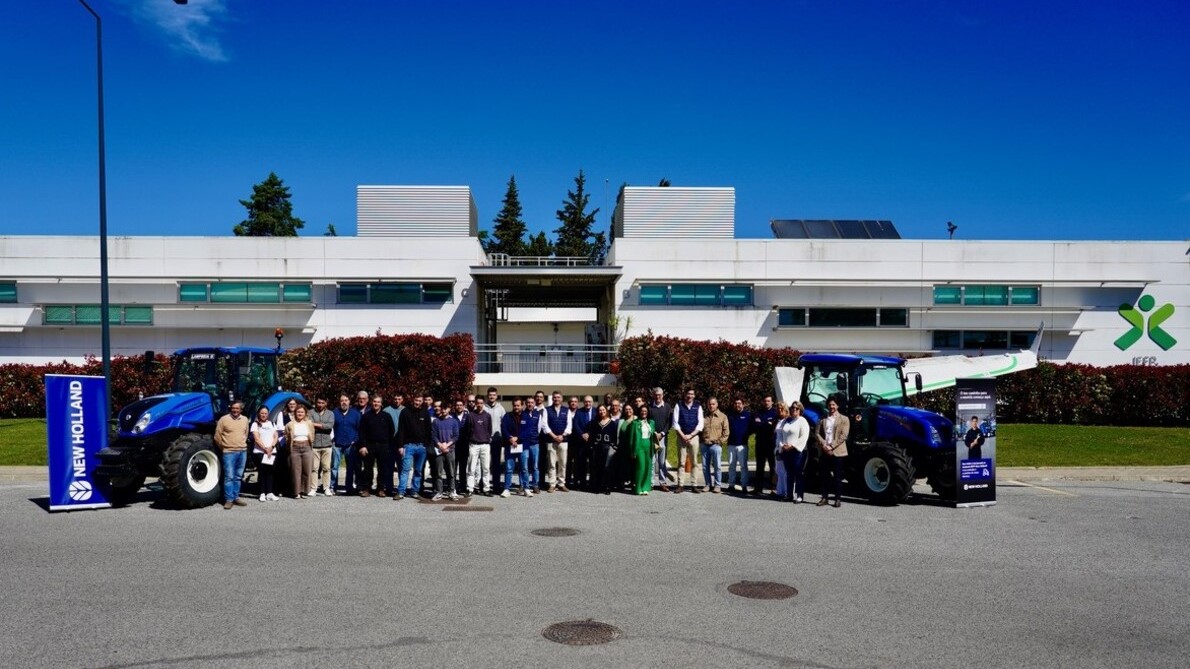
The New Holland Academy by IEFP has officially started in Évora, with a first intake of 14 trainees and a training program combining 500 hours of theoretical and practical instruction with 210 hours of on-the-job training. This joint initiative by New Holland and the IEFP of Évora aims to strengthen technical skills and respond to the shortage of professionals in agricultural mechanization in Portugal.
New Holland and the Institute for Employment and Vocational Training (IEFP) have launched, in Évora, the New Holland Academy by IEFP—an innovative pilot project developed in a context where the sector is facing significant structural recruitment challenges.
“There are areas where the only people available to recruit have virtually no background or technical training,” said João Pedro Rego, New Holland Service Delegate in Portugal, highlighting a reality that limits workshop responsiveness and the integration of new technicians.
Training aligned with real-world needs
More than just a training initiative, the Academy was designed to directly address this skills gap.
“The objective is to provide the essential foundations so that technicians can be more productive when they enter or return to a dealership,” added João Pedro Rego.
The program covers areas such as mechanics, electricity, electronics, hydraulics, engines, exhaust gas after-treatment systems, and even the operation of agricultural machinery, integrating a strong hands-on component using real equipment and New Holland–specific training content.
The technological evolution of machinery and increasing pressure on dealerships have changed the traditional in-company training model.
“Today, a technician who starts work needs to be productive the very next day. There is no longer time to train people for two or three years inside companies,” João Pedro Rego underlined.
For New Holland, this partnership also represents a long-term commitment. Agustí Garcia, Iberian Head of Technical Training, highlighted that “the agreement with IEFP Évora makes it possible to create a solid base of new technicians, capable of entering the dealer network and growing in a sector that requires continuous learning.”
Impact on the dealer network and attraction of new professionals
Technical qualification is directly linked to the quality of service provided to customers.
“A tractor is a working machine, and when it is stopped our response must be fast and satisfactory for the customer,” said Miguel Espogeiro, New Holland Commercial Director in Portugal, for whom this project represents “a pioneering initiative, with ambitions for continuity and a strong impact on the dealer network. Our dealers see this Academy as an investment in the future of the sector.”
From the IEFP side, José Francisco Costa, Director of Employment and Vocational Training Services at the Alentejo Regional Delegation, emphasized “the importance of this type of collaboration between public entities and companies, noting that the evolution of agriculture and mechanization requires professionals with increasingly advanced technological skills.”
Paula Caeiro, Director of the Évora Employment and Vocational Training Center, described the initiative as pioneering in the field of agricultural mechanization, having been jointly developed with the company to address specific market needs.
The Academy’s appeal is also reflected in the perspective of the trainees themselves. Carlos Maltês, 21 years old, already works at a New Holland dealership and sees this opportunity as a way to strengthen his skills.
“It’s an area with a future and guaranteed employment,” he said.
For Gabriela Murta, the only woman among the 14 trainees, the Academy represents an opportunity to expand her knowledge in a rapidly evolving field. She summarised her goal simply:
“My focus is precision agriculture, and agricultural mechanization is a key component of this area—especially within a brand like New Holland, with its strong technological know-how.”
A long-term commitment
With the launch of this first edition, New Holland and IEFP are laying the foundations for what they intend to be a long-term project. Although the future format will depend on the evaluation of this initial phase, there is a shared ambition to consolidate the Academy as a structural solution to the shortage of technicians in the sector—ensuring that this is just the first of several planned editions to strengthen the national market.
Lisbon, April 20, 2026