
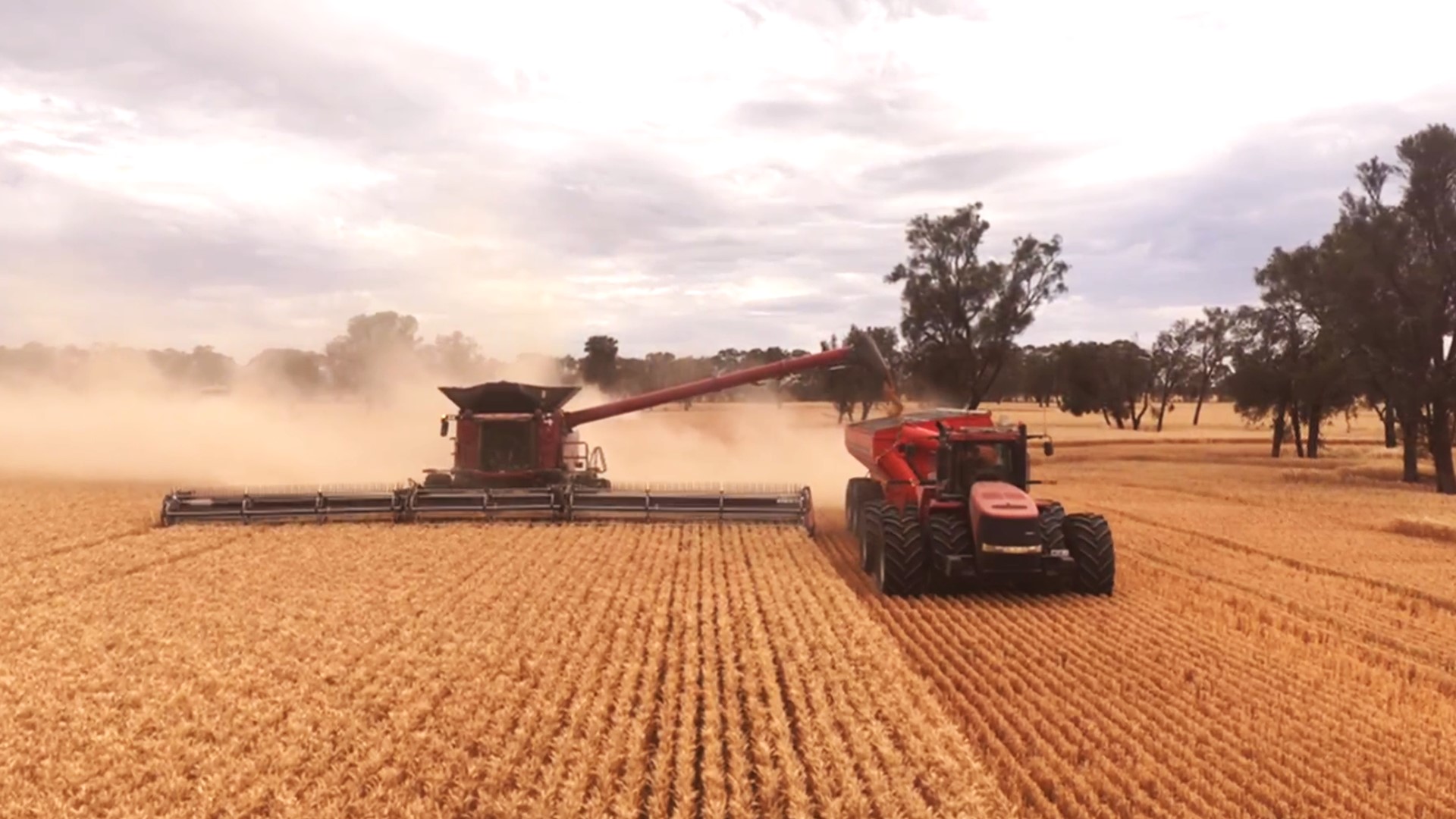
Harvest for the Hallam family wrapped up just before Christmas, with a bit more at stake this year as four new members of the team were put through their paces, with a lot riding on how they performed.
Pat Hallam and his family farm 12,000ha at Hopetoun, Victoria, north-west of Melbourne, with another 1200ha to the south near Horsham.
In October, just prior to the start of their annual harvest, the Hallams took delivery of four new Case IH AF10 combines, the brand’s latest offering in the local harvester market and its highest horsepower and biggest capacity combine ever in Australia.
The four newcomers were immediately put to work, with the harvest of wheat, barley, canola and lentils beginning not long after their arrival, and Pat Hallam couldn’t have been happier with the power, performance and efficiency they displayed.
“They went really well, we’ve been very happy with how they performed, right across the board,” Pat said.
“As an example, we had 4700 hectares of lentils, and you're stripping them at about 9km/hr, and we just got over them so quick. About 10 days and they were done.”
The business previously operated three Case IH 8250 combines, and would get a local contractor in with two other machines. When it came time to upgrade, Pat had heard about the launch of the new AF Series, and its greater size and capacity, and through his local dealer, O’Connors, had the chance to see an AF10 at a demonstration event in Victoria in 2024. He was impressed by what he saw.
“The fact they were that much bigger than previous series, with the capacity to get through more tons an hour and able to easily handle a bigger front, we thought, yes, that’s where we need to be for our business,” Pat said.
“We could have looked at other brands, but what we saw with the AF10, and the fact our dealer’s always looked after us with whatever we’ve needed, that convinced us they were what we were after.”
They had 50ft fronts on their 8250s, but Pat said being able to fit 60ft MacDon fronts to the AF10s was a real game-changer when it came to getting through the crop faster and more efficiently.
“They just powered through and left the paddocks really neat. The headers marry up with the fronts so well, they really complement each other. We did a lot of drop tray testing behind the headers to see what’s coming out the back of them, and the losses were well below 1%. We were wrapped with them,” Pat said.
Another difference Pat noticed was a reduction in rotor hours.
“Our four AF10s this year, combined, have done about 1200 rotor hours to get that harvest done. Last year, to do the equivalent areas of crops, our three headers did 350 rotor hours plus the contractor’s machines would have done about 500 rotor hours. So, you're looking at more than 1500 rotor hours between all the machines,” Pat said.
“To be able to pull it back from 1500 to 1600 rotor hours to 1200 with four harvesters rather than five, that’s a great result.”
Pat said they’d also gone from averaging about 170-180 tonne/hr with their cereal crops using the five harvesters last year, to between 240 and 250 tonnes/hr this year with the four AF10s.
Marc Smith, Crop Harvesting Portfolio Manager for CNH Australia and New Zealand, said the new AF Series had attracted a lot of interest from local producers, and with the first machines arriving in Australia in October, the feedback from owners had been very positive.
“With this series, there’s an emphasis on increased horsepower to provide the power to maximise crop flow while increasing speeds, but without putting any additional pressure on the machine. Alongside this elevation in power and performance is a full suite of precision technology which make operating the combines more intuitive and efficient,” he said.
Pat agreed the technology offering in the AF10s was impressive, with access to more data and information and upgraded screens. With the AF Series, greater control and consistency in harvest are found through tailored visibility in the dual Pro 1200 displays as well as real-time machine monitoring, remote view of in-cab displays and visualisation of agronomic data layers through FieldOps.
Despite a season Pat described as “extremely dry”, he said crop yields were about on par with 2024, something he’s grateful for and which he attributes in part to the efficiency of his new headers.
“It’s obviously a massive investment in these four machines, but the kind of capacity we have now, it’s just made all the difference, and in terms of efficiency, there’s savings there, too,” Pat said.
“And, I think we’ll make it up in the fact that we’ve got four rather than three machines now, so we no longer have to pay a contractor, and we’re getting the crop off that much faster. There’s a lot of people who say that for every day after your crop's right, you're losing money, so the faster we can get it in, the better.”
For more information on the AF10 Series, contact your local Case IH dealer.