
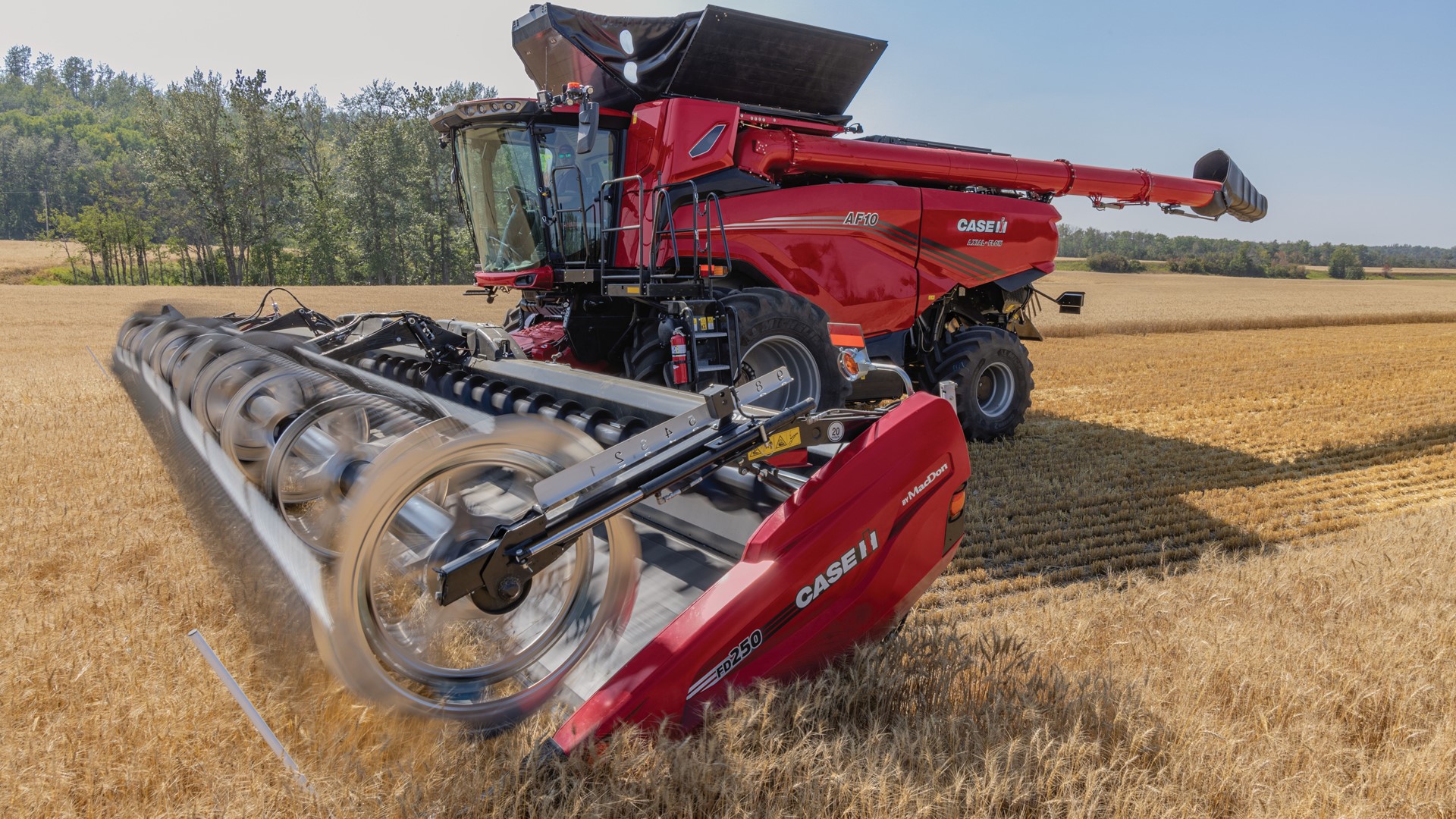
For Glen Baxter, it’s important to make every grain count, so when the new Case IH AF9 and AF10 combines were released he knew he had to be one of the first to try them.
Based in Berrigan, in southern New South Wales, Glen works alongside his brother Noel and father Kelvin as part of the Namarang Farms Partnership. The multi-generational farming family has been in business for more than 100 years, with Glen and Noel currently responsible for the farming operation.
In winter the family grows wheat, canola, barley, faba beans and vetch, whilst the summer cropping programme is based around maize and cotton.
The scale of the 14,000-hectare farming operation means Namarang Farms employs 13 full-time staff but increases to as many as 25 during busy harvest periods. The business runs five combine harvesters, with the AF9 and AF10 joining three Case IH Axial-Flow 8250 combines late last year.
“The transition from the 8250s to the AF series combines has been straightforward but there is obviously a big difference with efficiencies and the potential for higher productivity,” Glen said.
The new machines are fitted with 50-foot fronts but the variance in capacity has been noticeable during cereal harvesting. With the AF9’s 16,000-litre grain tank and the AF10’s 20,000-litre grain tank, Glen estimates there’s a 15-to 20-tonne-per-hour difference in volume when the two machines are working at maximum capacity. He adds that he believes when the AF10 is running at full capacity, it can manage about 1.7 times the volume of an 8250 combine.
The increased productivity has helped reduce the pressure on labour and with the combines’ improved efficiency, from its higher capacity and larger grain tanks, he says it helps the whole harvest programme flow more effectively, from combine to silo.
The benefits keep on stacking up for Glen.
“As we get to know the machines better, I can see some gains in fuel efficiency and other benefits to the next season's spraying and sowing programme, with reduced grain loss and stubble management,” he said.
Technology is another area where Glen has noticed a significant difference. He particularly likes using Case IH FieldOps™, which allows him to remotely view machine settings and productivity to make sure they’re operating to their maximum ability.
“With the tech advancements, you can log in to FieldOps and make sure that the machines are performing how they should be. It saves you time and reduces avoidable delays because if they’re not performing, you can address the issue sooner.”
Among his favourite precision tech features are the radar spreaders, which he says have made stubble management easier, along with the improved automation and feed-rate control.
“The spreaders do a great job, with minimal management,” he said. “The automation is a big improvement too. You can press a couple of buttons each time you turn the combine around in the paddock and the machine looks after its speed, grain loss and everything for you.”
The AF cab has also received a positive response from Glen and his operators. More space, two Pro 1200 displays, a massage seat and features such as automatic de-slugging, a remote rock trap dump feature and the ability to change rotor gears in-cab all reduce the need for the operator to get out of the machine often.
“They’re all things to make it easier for the operator,” Glen said. “Having two Pro 1200s in the cab definitely saves you from jumping around on screens often and gives you the ability to see the whole picture right in front of you, at all times.”
For Glen, the performance of the machines is only part of the equation. The relationship with his Case IH dealer, O’Connors Shepparton, has been equally important.
“Dealer support is honestly excellent from sales to tech to parts; their communication and recognition of the importance of supporting our business, is great,” Glen said. “They really do take the extra steps to form a relationship and look after their customers. That makes us feel part of the O'Connors and Case IH family.”
He also credits the dealer’s practical training for helping his team get more from their investment, including hands-on AF training and detailed seasonal setting guides.
After one season with the AF9 and AF10, Glen is already looking ahead to what the machines can deliver in the coming harvest.
For him the 2026 season is shaping up strongly. Namarang Farms currently has around 4,000 hectares of canola, 4,800 hectares of wheat, 2,600 hectares of barley, 300 hectares of faba beans and 100 hectares of vetch in the current winter program, with harvest expected to begin around late October or early November.
“At the moment, I couldn’t be happier,” Glen said. “Yield-wise, it’s currently shaping up as the equal best season I’ve ever seen in our area since 2020.”